The central challenge is gaining authority without exposing clients to irrelevant, manipulative, or low-quality links. Consider an agency building local and industry links for dental and trade-service clients. This guide turns that situation into a practical, reviewable plan for agencies and local businesses—covering the decisions, deliverables, review checks and measurements needed for real delivery.
Define acceptable tactics, site criteria, approval rules, anchors, and reporting before outreach begins. This guide focuses on strategy, prospect quality, relevance, outreach, editorial standards, anchors, and transparency, with practical checks for deciding what to do next.
- Define acceptable tactics, site criteria, approval rules, anchors, and reporting before outreach begins.
- Prioritise strategy, prospect quality, relevance, outreach before expanding the scope or production volume.
- Track Relevant Links Earned, Target-Page Movement, Prospect Acceptance with consistent definitions and data sources.
- Record approvals, dependencies and implementation evidence so delays and ownership stay visible.
Primary-source note: Google Search spam policies. Google defines links created mainly to manipulate rankings as link spam, so relevance, editorial purpose and transparent tactics are essential.
How to apply the framework in practice
Use the example of an agency building local and industry links for dental and trade-service clients as a test. The plan should explain what happens first, what can wait, what the business must supply, how quality is approved and which signal would justify expanding the scope. If those answers are missing, more content, more keywords or more reports will usually add management load before they add value.
1. Strategy
Treat strategy as a decision point in the workflow. Document the inputs, expected output, owner and review standard so this part of “SEO Link Building Outsourcing: How to Protect Quality and Brand Safety” can be checked and improved instead of simply marked complete.
2. Prospect Quality
Approve the prospect standard before outreach. Review topical relevance, real audience, editorial quality, ownership, traffic patterns, outbound-link behaviour and placement context. Use natural anchors and disclose costs, rejections and substitutions rather than presenting every acquired link as equal.
3. Relevance
Approve the prospect standard before outreach. Review topical relevance, real audience, editorial quality, ownership, traffic patterns, outbound-link behaviour and placement context. Use natural anchors and disclose costs, rejections and substitutions rather than presenting every acquired link as equal.
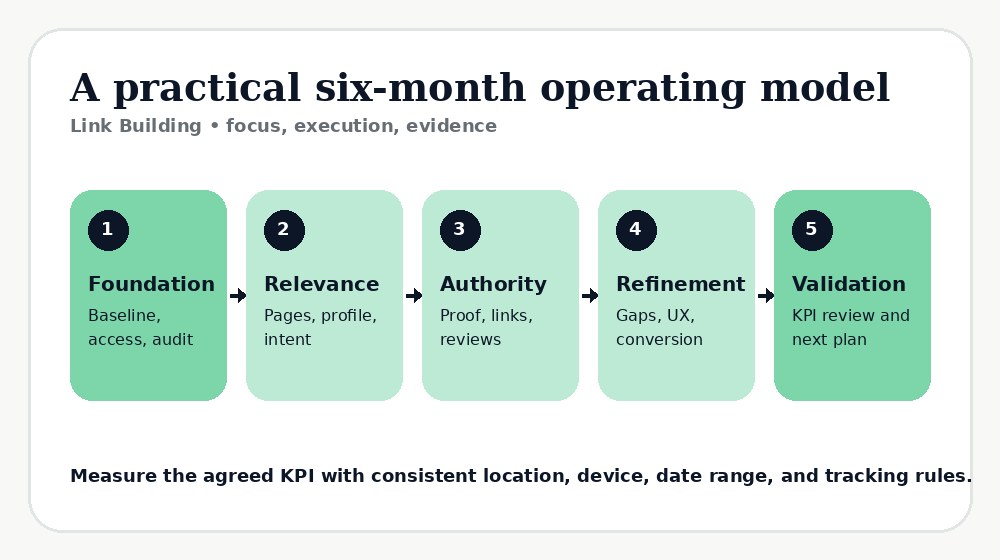
4. Outreach
Approve the prospect standard before outreach. Review topical relevance, real audience, editorial quality, ownership, traffic patterns, outbound-link behaviour and placement context. Use natural anchors and disclose costs, rejections and substitutions rather than presenting every acquired link as equal.
5. Editorial Standards
Combine automated checks with accountable human review. Tools can detect missing fields, broken links and formatting problems; a qualified reviewer must still judge intent, factual accuracy, brand fit, risk and whether the recommendation is worth implementing.
6. Anchors
Approve the prospect standard before outreach. Review topical relevance, real audience, editorial quality, ownership, traffic patterns, outbound-link behaviour and placement context. Use natural anchors and disclose costs, rejections and substitutions rather than presenting every acquired link as equal.
7. Transparency
Approve the prospect standard before outreach. Review topical relevance, real audience, editorial quality, ownership, traffic patterns, outbound-link behaviour and placement context. Use natural anchors and disclose costs, rejections and substitutions rather than presenting every acquired link as equal.
Delivery checklist and acceptance tests
Use this table as an acceptance checklist. Each row should leave behind evidence that another reviewer can inspect.
| Workstream | Required output | Acceptance check |
|---|---|---|
| Strategy | A concise strategy record covering the decision, supporting evidence, owner and next action. | The strategy work is specific, evidence-backed and ready for the next owner or implementation step. |
| Prospect Quality | an approved prospect record with relevance notes, contact history, placement context and final destination URL | the site and placement are relevant, editorially credible, transparent and safe for the client brand |
| Relevance | A concise relevance record covering the decision, supporting evidence, owner and next action. | The relevance work is specific, evidence-backed and ready for the next owner or implementation step. |
| Outreach | an approved prospect record with relevance notes, contact history, placement context and final destination URL | the site and placement are relevant, editorially credible, transparent and safe for the client brand |
| Editorial Standards | A concise editorial standards record covering the decision, supporting evidence, owner and next action. | The editorial standards work is specific, evidence-backed and ready for the next owner or implementation step. |
| Anchors | A concise anchors record covering the decision, supporting evidence, owner and next action. | The anchors work is specific, evidence-backed and ready for the next owner or implementation step. |
How to measure progress without vanity reporting
For SEO Link Building Outsourcing: How to Protect Quality and Brand Safety, separate implementation signals from business outcomes. Keep the data source, filters and date range consistent so changes can be compared fairly.
- Relevant Links Earned: Define the source, owner, date range and decision this measure supports. Keep the method stable, annotate major changes and avoid reporting the number without an interpretation or next action.
- Target-Page Movement: Define the source, owner, date range and decision this measure supports. Keep the method stable, annotate major changes and avoid reporting the number without an interpretation or next action.
- Prospect Acceptance: Score against written acceptance criteria and record the reason for each revision. First-pass acceptance is more useful than total output because it exposes brief quality, reviewer consistency and recurring process defects.
- Removal Risk: Define the source, owner, date range and decision this measure supports. Keep the method stable, annotate major changes and avoid reporting the number without an interpretation or next action.
- Referral Value: Use fully loaded cost and attributable or assisted revenue where the data is credible. State attribution limitations and compare the trend by service or account rather than relying on a single blended average.
End each reporting cycle with an operational decision: keep, correct, consolidate, expand or stop the workstream. Separate delivery-team output from items blocked by access, approval or implementation.
Common mistakes that weaken results
1. Buying links by domain score alone
A placement bought for a metric can expose the client to irrelevant audiences, poor editorial environments and removal risk. Approve prospects by topical fit, real readership, editorial reason and placement context, and document paid or exchanged value transparently.
2. Hiding placement costs
Treat “Hiding placement costs” as a review failure, not a minor exception. Define what good looks like for this point, require supporting evidence, and correct the process if the same issue appears again.
3. Forcing commercial anchors
Treat “Forcing commercial anchors” as a review failure, not a minor exception. Define what good looks like for this point, require supporting evidence, and correct the process if the same issue appears again.
4. Accepting unrelated sites
A placement bought for a metric can expose the client to irrelevant audiences, poor editorial environments and removal risk. Approve prospects by topical fit, real readership, editorial reason and placement context, and document paid or exchanged value transparently.
5. Reporting links without context
Treat “Reporting links without context” as a review failure, not a minor exception. Define what good looks like for this point, require supporting evidence, and correct the process if the same issue appears again.
A practical 90-day implementation sequence
Days 1–30: baseline and control
Start with strategy, prospect quality. Establish the baseline, access, owners and acceptance criteria before increasing production volume.
Days 31–60: build the priority assets
Implement relevance, outreach. Review early outputs closely and turn repeated corrections into better briefs, templates or automated checks.
Days 61–90: validate and expand carefully
Validate editorial standards, anchors, transparency. Compare the new evidence with the baseline, then expand only the work that is producing reliable quality or commercial progress.
Related reading
- Local Link Building: A Practical Guide for Dentists and Tradies
- On-Page SEO Outsourcing: A Quality Framework for Agencies
- SEO Outsourcing Philippines
Need SEO delivery support support?
See how our seo outsourcing services workflow can support implementation after the recommendations in this guide.