The central challenge is producing consistent recommendations that reflect search intent and brand context. Consider an agency optimising service pages for dentists, roofers, and electricians. This guide turns that situation into a practical, reviewable plan for agencies and local businesses—covering the decisions, deliverables, review checks and measurements needed for real delivery.
Standardise analysis while preserving page-specific judgement and conversion quality. This guide focuses on keyword mapping, titles, headings, copy, internal links, entities, media, and qa, with practical checks for deciding what to do next.
- Standardise analysis while preserving page-specific judgement and conversion quality.
- Prioritise keyword mapping, titles, headings, copy before expanding the scope or production volume.
- Track First-Pass Approval, Page-One Movement, Organic Entrances with consistent definitions and data sources.
- Record approvals, dependencies and implementation evidence so delays and ownership stay visible.
Primary-source note: Google title-link guidance. Google recommends descriptive, concise title text and warns against vague, boilerplate or keyword-stuffed titles.
How to apply the framework in practice
Use the example of an agency optimising service pages for dentists, roofers, and electricians as a test. The plan should explain what happens first, what can wait, what the business must supply, how quality is approved and which signal would justify expanding the scope. If those answers are missing, more content, more keywords or more reports will usually add management load before they add value.
1. Keyword Mapping
Separate a small accountability set from a broader research set. The KPI set should represent distinct commercial intents with a valid page and fixed tracking method; variants and long-tail queries can be monitored for insight without becoming separate promises.
2. Titles
Align the title, main heading and body with the page’s actual purpose. Use natural terminology customers and subject experts recognise, cover the entities needed to explain the topic, and remove boilerplate that could be swapped onto any competitor page.
3. Headings
Align the title, main heading and body with the page’s actual purpose. Use natural terminology customers and subject experts recognise, cover the entities needed to explain the topic, and remove boilerplate that could be swapped onto any competitor page.
4. Copy
Align the title, main heading and body with the page’s actual purpose. Use natural terminology customers and subject experts recognise, cover the entities needed to explain the topic, and remove boilerplate that could be swapped onto any competitor page.
5. Internal Links
Use internal links to connect related services, locations, guides and proof. Link from pages with context and authority to the page that best satisfies the next question. Avoid sitewide exact-match anchors or automated blocks that create hundreds of low-value links.
6. Entities
Align the title, main heading and body with the page’s actual purpose. Use natural terminology customers and subject experts recognise, cover the entities needed to explain the topic, and remove boilerplate that could be swapped onto any competitor page.
7. Media
Use original, recent images that prove the business, people, equipment and completed work. Compress files, set accurate dimensions and descriptive alternative text, and avoid uploading the same generic stock image across multiple location or service pages.
8. Quality assurance
Combine automated checks with accountable human review. Tools can detect missing fields, broken links and formatting problems; a qualified reviewer must still judge intent, factual accuracy, brand fit, risk and whether the recommendation is worth implementing.
Delivery checklist and acceptance tests
Use this table as an acceptance checklist. Each row should leave behind evidence that another reviewer can inspect.
| Workstream | Required output | Acceptance check |
|---|---|---|
| Keyword Mapping | an approved intent-to-page map with the KPI terms, supporting queries, target URL and rationale | every target has distinct intent, a credible page and a reproducible tracking setup |
| Titles | a brief or page specification with intent, required evidence, structure, internal links and conversion action | the page answers the query, uses approved evidence, avoids unsupported claims and offers a clear next step |
| Headings | a brief or page specification with intent, required evidence, structure, internal links and conversion action | the page answers the query, uses approved evidence, avoids unsupported claims and offers a clear next step |
| Copy | a brief or page specification with intent, required evidence, structure, internal links and conversion action | the page answers the query, uses approved evidence, avoids unsupported claims and offers a clear next step |
| Internal Links | an internal-link map showing source page, destination page, anchor context, user purpose and implementation status | each link is useful in context, points to the best destination and is present on the live page |
| Entities | A concise entities record covering the decision, supporting evidence, owner and next action. | The entities work is specific, evidence-backed and ready for the next owner or implementation step. |
How to measure progress without vanity reporting
For On-Page SEO Outsourcing: A Quality Framework for Agencies, separate implementation signals from business outcomes. Keep the data source, filters and date range consistent so changes can be compared fairly.
- First-Pass Approval: Define the source, owner, date range and decision this measure supports. Keep the method stable, annotate major changes and avoid reporting the number without an interpretation or next action.
- Page-One Movement: Define the source, owner, date range and decision this measure supports. Keep the method stable, annotate major changes and avoid reporting the number without an interpretation or next action.
- Organic Entrances: Review non-branded performance by landing page and query theme. Look for growth on priority service pages and compare it with engagement and qualified actions so informational traffic is not mistaken for commercial progress.
- Conversion Rate: Define the source, owner, date range and decision this measure supports. Keep the method stable, annotate major changes and avoid reporting the number without an interpretation or next action.
- Internal-Link Coverage: Define the source, owner, date range and decision this measure supports. Keep the method stable, annotate major changes and avoid reporting the number without an interpretation or next action.
End each reporting cycle with an operational decision: keep, correct, consolidate, expand or stop the workstream. Separate delivery-team output from items blocked by access, approval or implementation.
Common mistakes that weaken results
1. Forcing exact-match keywords
Treat “Forcing exact-match keywords” as a review failure, not a minor exception. Define what good looks like for this point, require supporting evidence, and correct the process if the same issue appears again.
2. Rewriting without brand context
Treat “Rewriting without brand context” as a review failure, not a minor exception. Define what good looks like for this point, require supporting evidence, and correct the process if the same issue appears again.
3. Optimising pages for competing intents
Treat “Optimising pages for competing intents” as a review failure, not a minor exception. Define what good looks like for this point, require supporting evidence, and correct the process if the same issue appears again.
4. Ignoring conversion copy
Treat “Ignoring conversion copy” as a review failure, not a minor exception. Define what good looks like for this point, require supporting evidence, and correct the process if the same issue appears again.
5. Changing metadata without tracking
The resulting number may look precise but cannot support a fair decision. Use fixed tools, locations, filters and date ranges, then report negative and positive movement together with conversions and implementation context.
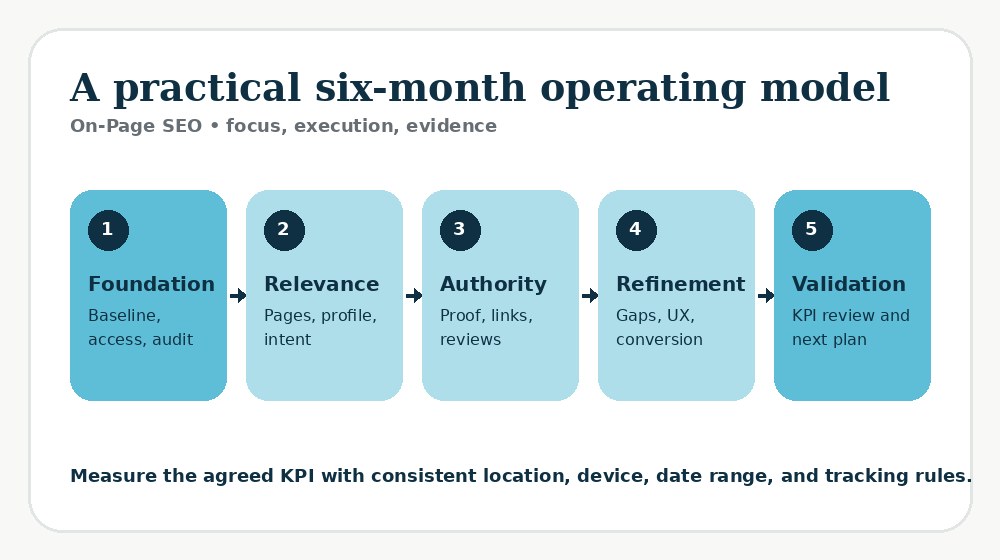
A practical 90-day implementation sequence
Days 1–30: baseline and control
Start with keyword mapping, titles. Establish the baseline, access, owners and acceptance criteria before increasing production volume.
Days 31–60: build the priority assets
Implement headings, copy, internal links. Review early outputs closely and turn repeated corrections into better briefs, templates or automated checks.
Days 61–90: validate and expand carefully
Validate entities, media, qa. Compare the new evidence with the baseline, then expand only the work that is producing reliable quality or commercial progress.
Related reading
- Local Link Building: A Practical Guide for Dentists and Tradies
- How to Outsource SEO Content Without Sacrificing Brand Voice
- SEO Outsourcing Philippines
Need on-page and content optimisation support?
See how our seo content outsourcing workflow can support implementation after the recommendations in this guide.