
The central challenge is turning hundreds of crawl findings into a realistic action plan. Consider an agency auditing a 5,000-page local services website before a redesign. This guide turns that situation into a practical, reviewable plan for agencies and local businesses—covering the decisions, deliverables, review checks and measurements needed for real delivery.
Prioritise issues by impact, confidence, effort, and dependency rather than tool severity labels. This guide focuses on crawlability, indexation, architecture, internal links, performance, structured data, and implementation, with practical checks for deciding what to do next.
- Prioritise issues by impact, confidence, effort, and dependency rather than tool severity labels.
- Prioritise crawlability, indexation, architecture, internal links before expanding the scope or production volume.
- Track Indexed Valuable Pages, Crawl Waste, Implementation Completion with consistent definitions and data sources.
- Record approvals, dependencies and implementation evidence so delays and ownership stay visible.
Primary-source note: Google Search Console and Core Web Vitals guidance. Google recommends monitoring real-world loading, responsiveness and visual stability through LCP, INP and CLS, alongside Search Console indexing and performance data.
How to apply the framework in practice
Use the example of an agency auditing a 5,000-page local services website before a redesign as a test. The plan should explain what happens first, what can wait, what the business must supply, how quality is approved and which signal would justify expanding the scope. If those answers are missing, more content, more keywords or more reports will usually add management load before they add value.
1. Crawlability
Confirm that important URLs can be discovered, fetched, rendered and indexed as intended. Review robots rules, canonicals, status codes, sitemaps, internal links and index reports together; no single crawl flag explains the full indexing state.
2. Indexation
Confirm that important URLs can be discovered, fetched, rendered and indexed as intended. Review robots rules, canonicals, status codes, sitemaps, internal links and index reports together; no single crawl flag explains the full indexing state.
3. Architecture
Use a hierarchy that reflects services and genuine locations without creating unnecessary depth. Stable, readable URLs and consistent breadcrumbs help users and crawlers understand relationships; changing them requires redirects, internal-link updates and careful validation.
4. Internal Links
Use internal links to connect related services, locations, guides and proof. Link from pages with context and authority to the page that best satisfies the next question. Avoid sitewide exact-match anchors or automated blocks that create hundreds of low-value links.
5. Performance
Prioritise real-user performance on important templates. Review Largest Contentful Paint, Interaction to Next Paint and Cumulative Layout Shift alongside conversion and device data, then fix shared template causes before isolated low-traffic pages.
6. Structured Data
Use structured data only when it matches visible page content and an eligible type. Validate syntax, required properties and template coverage, but do not treat markup as a substitute for clear content, trustworthy business information or technical accessibility.
7. Implementation
Assign every recommendation to an owner and require evidence of deployment. For code or template changes, record the release date and affected URLs; for content or profile work, keep the approved version and a live URL. Re-test after implementation rather than assuming a closed task equals a fixed problem.
Delivery checklist and acceptance tests
Use this table as an acceptance checklist. Each row should leave behind evidence that another reviewer can inspect.
| Workstream | Required output | Acceptance check |
|---|---|---|
| Crawlability | a prioritised issue log with affected templates, impact, confidence, effort, owner and verification evidence | the recommendation is prioritised, deployed by an owner and confirmed through a re-test |
| Indexation | a prioritised issue log with affected templates, impact, confidence, effort, owner and verification evidence | the recommendation is prioritised, deployed by an owner and confirmed through a re-test |
| Architecture | a prioritised issue log with affected templates, impact, confidence, effort, owner and verification evidence | The architecture work is specific, evidence-backed and ready for the next owner or implementation step. |
| Internal Links | an internal-link map showing source page, destination page, anchor context, user purpose and implementation status | each link is useful in context, points to the best destination and is present on the live page |
| Performance | a prioritised issue log with affected templates, impact, confidence, effort, owner and verification evidence | the recommendation is prioritised, deployed by an owner and confirmed through a re-test |
| Structured Data | a prioritised issue log with affected templates, impact, confidence, effort, owner and verification evidence | The structured data work is specific, evidence-backed and ready for the next owner or implementation step. |
How to measure progress without vanity reporting
For Technical SEO Audits for Agencies: How to Prioritise What Matters, separate implementation signals from business outcomes. Keep the data source, filters and date range consistent so changes can be compared fairly.
- Indexed Valuable Pages: Define the source, owner, date range and decision this measure supports. Keep the method stable, annotate major changes and avoid reporting the number without an interpretation or next action.
- Crawl Waste: Define the source, owner, date range and decision this measure supports. Keep the method stable, annotate major changes and avoid reporting the number without an interpretation or next action.
- Implementation Completion: Measure from a defined start to an accepted finish and separate active work from time blocked by access or approval. The trend should help capacity planning and reveal bottlenecks, not reward rushed handoffs.
- Organic Landing-Page Growth: Define the source, owner, date range and decision this measure supports. Keep the method stable, annotate major changes and avoid reporting the number without an interpretation or next action.
- Technical Regression Rate: Define the source, owner, date range and decision this measure supports. Keep the method stable, annotate major changes and avoid reporting the number without an interpretation or next action.
End each reporting cycle with an operational decision: keep, correct, consolidate, expand or stop the workstream. Separate delivery-team output from items blocked by access, approval or implementation.
Common mistakes that weaken results
1. Exporting tool errors as the report
Treat “Exporting tool errors as the report” as a review failure, not a minor exception. Define what good looks like for this point, require supporting evidence, and correct the process if the same issue appears again.
2. Treating every issue equally
Treat “Treating every issue equally” as a review failure, not a minor exception. Define what good looks like for this point, require supporting evidence, and correct the process if the same issue appears again.
3. Ignoring business context
Treat “Ignoring business context” as a review failure, not a minor exception. Define what good looks like for this point, require supporting evidence, and correct the process if the same issue appears again.
4. Recommending changes without owners
Work stalls when nobody owns the decision or deployment. Put the approver, due date, dependency and escalation path on the task, and show blocked time separately so it is not mistaken for completed delivery.
5. Failing to re-crawl
Treat “Failing to re-crawl” as a review failure, not a minor exception. Define what good looks like for this point, require supporting evidence, and correct the process if the same issue appears again.
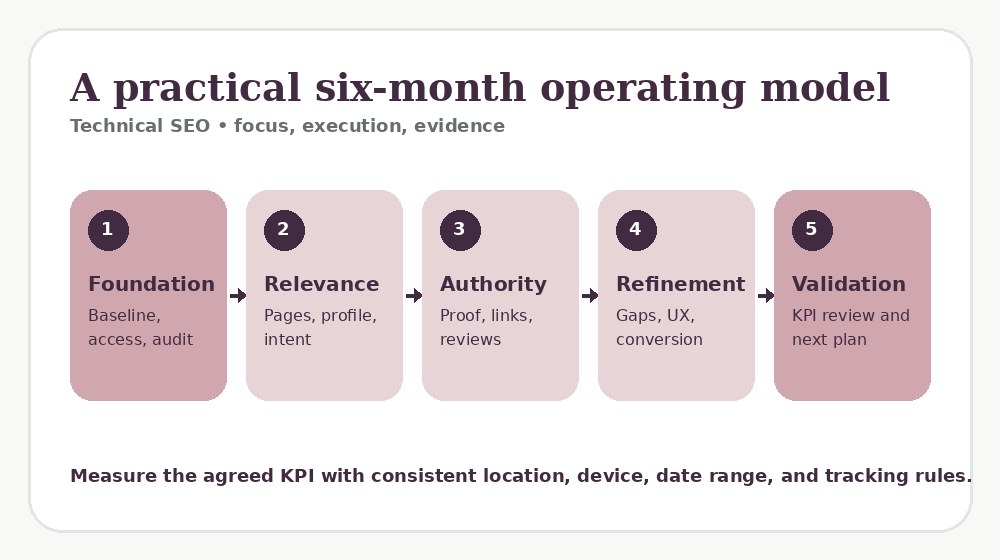
A practical 90-day implementation sequence
Days 1–30: baseline and control
Start with crawlability, indexation. Establish the baseline, access, owners and acceptance criteria before increasing production volume.
Days 31–60: build the priority assets
Implement architecture, internal links. Review early outputs closely and turn repeated corrections into better briefs, templates or automated checks.
Days 61–90: validate and expand carefully
Validate performance, structured data, implementation. Compare the new evidence with the baseline, then expand only the work that is producing reliable quality or commercial progress.
Related reading
- Local Link Building: A Practical Guide for Dentists and Tradies
- On-Page SEO Outsourcing: A Quality Framework for Agencies
- SEO Outsourcing Philippines
Need technical SEO delivery support?
See how our technical seo outsourcing workflow can support implementation after the recommendations in this guide.