The central challenge is setting targets that are either too vague to manage or too aggressive to be credible. Consider a starter plan targeting three page-one results from a five-keyword set in a lower-competition suburb. This guide turns that situation into a practical, reviewable plan for agencies and local businesses—covering the decisions, deliverables, review checks and measurements needed for real delivery.
Use baselines, competition, website condition, service area, and implementation speed to set a fair target. This guide focuses on keyword qualification, starting positions, serp analysis, site readiness, local competition, and validation, with practical checks for deciding what to do next.
- Use baselines, competition, website condition, service area, and implementation speed to set a fair target.
- Prioritise keyword qualification, starting positions, serp analysis, site readiness before expanding the scope or production volume.
- Track Page-One Attainment, Position Distribution, Serp Feature Presence with consistent definitions and data sources.
- Record approvals, dependencies and implementation evidence so delays and ownership stay visible.
Primary-source note: Google Search Essentials. Google recommends helpful, reliable, people-first content, crawlable links and descriptive language that helps users understand the page.
How to apply the framework in practice
Use the example of a starter plan targeting three page-one results from a five-keyword set in a lower-competition suburb as a test. The plan should explain what happens first, what can wait, what the business must supply, how quality is approved and which signal would justify expanding the scope. If those answers are missing, more content, more keywords or more reports will usually add management load before they add value.
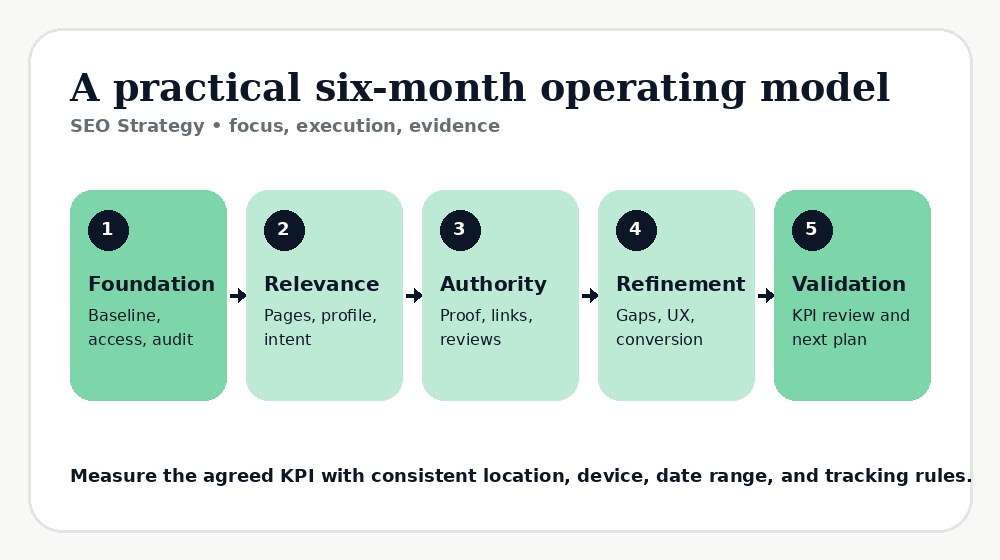
1. Keyword Qualification
Separate a small accountability set from a broader research set. The KPI set should represent distinct commercial intents with a valid page and fixed tracking method; variants and long-tail queries can be monitored for insight without becoming separate promises.
2. Starting Positions
Report the distribution of important terms across position bands rather than highlighting one winner. Movement from positions 30–50 into 11–20 can be meaningful progress, while a single branded term at number one may add little commercial value.
3. search results Analysis
Review the live search results before setting the plan. Note the page types, local businesses, directories, review profiles, content depth and authority patterns already winning. The goal is not to copy competitors but to understand the minimum credible standard and where a differentiated page can be better.
4. Site Readiness
Assess whether the site can support the target before promising an outcome. Check indexation, page quality, internal links, authority, conversion paths, development capacity and historical issues. A realistic target reflects the starting asset, not just search volume.
5. Local Competition
Review the live search results before setting the plan. Note the page types, local businesses, directories, review profiles, content depth and authority patterns already winning. The goal is not to copy competitors but to understand the minimum credible standard and where a differentiated page can be better.
6. Validation
Fix the measurement rules at the start: tool, location, device, date range, keyword spelling, page and treatment of maps or localised results. Keep screenshots or exports for baseline and final checks so the result can be reproduced.
Delivery checklist and acceptance tests
Use this table as an acceptance checklist. Each row should leave behind evidence that another reviewer can inspect.
| Workstream | Required output | Acceptance check |
|---|---|---|
| Keyword Qualification | an approved intent-to-page map with the KPI terms, supporting queries, target URL and rationale | every target has distinct intent, a credible page and a reproducible tracking setup |
| Starting Positions | A concise starting positions record covering the decision, supporting evidence, owner and next action. | The starting positions work is specific, evidence-backed and ready for the next owner or implementation step. |
| search results Analysis | an approved intent-to-page map with the KPI terms, supporting queries, target URL and rationale | every target has distinct intent, a credible page and a reproducible tracking setup |
| Site Readiness | A concise site readiness record covering the decision, supporting evidence, owner and next action. | The site readiness work is specific, evidence-backed and ready for the next owner or implementation step. |
| Local Competition | A concise local competition record covering the decision, supporting evidence, owner and next action. | The local competition work is specific, evidence-backed and ready for the next owner or implementation step. |
| Validation | A concise validation record covering the decision, supporting evidence, owner and next action. | The validation work is specific, evidence-backed and ready for the next owner or implementation step. |
How to measure progress without vanity reporting
For Page-One SEO Targets: How to Set Realistic Six-Month Expectations, separate implementation signals from business outcomes. Keep the data source, filters and date range consistent so changes can be compared fairly.
- Page-One Attainment: Define the source, owner, date range and decision this measure supports. Keep the method stable, annotate major changes and avoid reporting the number without an interpretation or next action.
- Position Distribution: Use the same keyword, business, device, search origin and tool each time. Report distribution and coverage, not only the best point, and connect movement to the page or profile changes made during the period.
- Serp Feature Presence: Define the source, owner, date range and decision this measure supports. Keep the method stable, annotate major changes and avoid reporting the number without an interpretation or next action.
- Traffic Lift: Review non-branded performance by landing page and query theme. Look for growth on priority service pages and compare it with engagement and qualified actions so informational traffic is not mistaken for commercial progress.
- Lead Contribution: Count the action by source, landing page, service and location, then review whether it was genuine, in scope and commercially useful. Raw volume should not include spam, existing-customer support or wrong-service enquiries.
End each reporting cycle with an operational decision: keep, correct, consolidate, expand or stop the workstream. Separate delivery-team output from items blocked by access, approval or implementation.
Common mistakes that weaken results
1. Choosing keywords after seeing movement
Treat “Choosing keywords after seeing movement” as a review failure, not a minor exception. Define what good looks like for this point, require supporting evidence, and correct the process if the same issue appears again.
2. Ignoring the starting baseline
Treat “Ignoring the starting baseline” as a review failure, not a minor exception. Define what good looks like for this point, require supporting evidence, and correct the process if the same issue appears again.
3. Using national terms for local campaigns
Treat “Using national terms for local campaigns” as a review failure, not a minor exception. Define what good looks like for this point, require supporting evidence, and correct the process if the same issue appears again.
4. Assuming every page can rank
Treat “Assuming every page can rank” as a review failure, not a minor exception. Define what good looks like for this point, require supporting evidence, and correct the process if the same issue appears again.
5. Measuring on one day
Treat “Measuring on one day” as a review failure, not a minor exception. Define what good looks like for this point, require supporting evidence, and correct the process if the same issue appears again.
A practical 90-day implementation sequence
Days 1–30: baseline and control
Start with keyword qualification, starting positions. Establish the baseline, access, owners and acceptance criteria before increasing production volume.
Days 31–60: build the priority assets
Implement serp analysis, site readiness. Review early outputs closely and turn repeated corrections into better briefs, templates or automated checks.
Days 61–90: validate and expand carefully
Validate local competition, validation. Compare the new evidence with the baseline, then expand only the work that is producing reliable quality or commercial progress.
Related reading
- SEO KPIs for a Six-Month Campaign: What to Track and Guarantee
- How to Structure a 100% SEO Refund Guarantee Responsibly
- SEO Outsourcing Philippines
Need SEO strategy execution support?
See how our seo outsourcing services workflow can support implementation after the recommendations in this guide.