
The central challenge is making a strong guarantee without creating unclear, misleading, or commercially impossible promises. Consider a six-month local SEO plan that refunds management fees if three of five agreed keywords do not reach page one. This guide turns that situation into a practical, reviewable plan for agencies and local businesses—covering the decisions, deliverables, review checks and measurements needed for real delivery.
Define a narrow KPI, measurement method, eligibility rules, cooperation duties, exclusions, and refund process. This guide focuses on offer design, legal clarity, keyword eligibility, baselines, measurement, exclusions, and disclosure, with practical checks for deciding what to do next.
- Define a narrow KPI, measurement method, eligibility rules, cooperation duties, exclusions, and refund process.
- Prioritise offer design, legal clarity, keyword eligibility, baselines before expanding the scope or production volume.
- Track Eligible Campaign Rate, KPI Attainment, Refund Exposure with consistent definitions and data sources.
- Record approvals, dependencies and implementation evidence so delays and ownership stay visible.
Primary-source note: Google Search Essentials. Google recommends helpful, reliable, people-first content, crawlable links and descriptive language that helps users understand the page.
How to apply the framework in practice
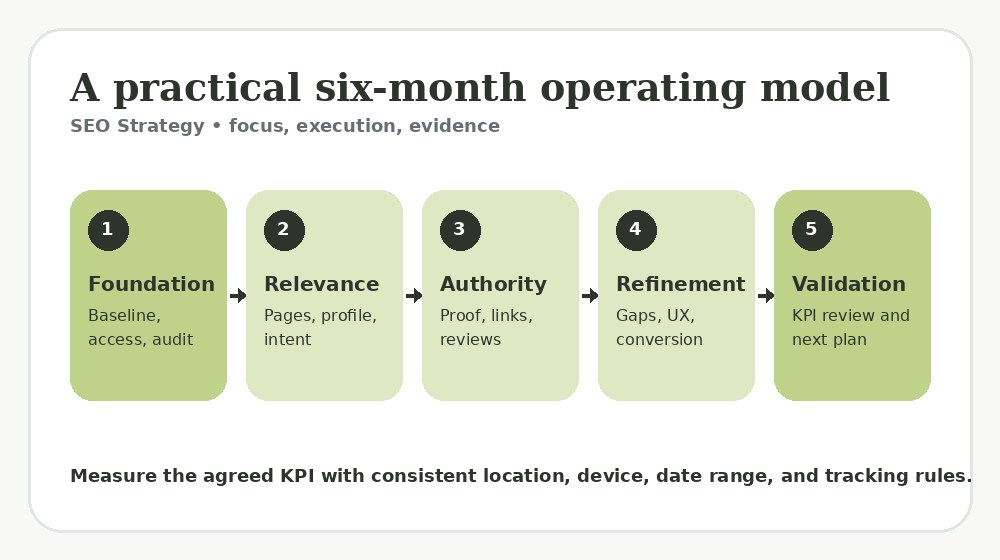
Use the example of a six-month local SEO plan that refunds management fees if three of five agreed keywords do not reach page one as a test. The plan should explain what happens first, what can wait, what the business must supply, how quality is approved and which signal would justify expanding the scope. If those answers are missing, more content, more keywords or more reports will usually add management load before they add value.
1. Offer Design
Define exactly what is guaranteed, how it is measured, which fees are refundable, what the client must do and which events suspend eligibility. Use plain language and obtain legal review for the jurisdictions in which the offer is sold.
2. Legal Clarity
Define exactly what is guaranteed, how it is measured, which fees are refundable, what the client must do and which events suspend eligibility. Use plain language and obtain legal review for the jurisdictions in which the offer is sold.
3. Keyword Eligibility
Define exactly what is guaranteed, how it is measured, which fees are refundable, what the client must do and which events suspend eligibility. Use plain language and obtain legal review for the jurisdictions in which the offer is sold.
4. Baselines
Treat baselines as a decision point in the workflow. Document the inputs, expected output, owner and review standard so this part of “How to Structure a 100% SEO Refund Guarantee Responsibly” can be checked and improved instead of simply marked complete.
5. Measurement
Fix the measurement rules at the start: tool, location, device, date range, keyword spelling, page and treatment of maps or localised results. Keep screenshots or exports for baseline and final checks so the result can be reproduced.
6. Exclusions
Define exactly what is guaranteed, how it is measured, which fees are refundable, what the client must do and which events suspend eligibility. Use plain language and obtain legal review for the jurisdictions in which the offer is sold.
7. Disclosure
Define exactly what is guaranteed, how it is measured, which fees are refundable, what the client must do and which events suspend eligibility. Use plain language and obtain legal review for the jurisdictions in which the offer is sold.
Delivery checklist and acceptance tests
Use this table as an acceptance checklist. Each row should leave behind evidence that another reviewer can inspect.
| Workstream | Required output | Acceptance check |
|---|---|---|
| Offer Design | A concise offer design record covering the decision, supporting evidence, owner and next action. | The offer design work is specific, evidence-backed and ready for the next owner or implementation step. |
| Legal Clarity | plain-language offer terms defining the KPI, eligible fees, measurement method, client duties and exclusions | the client can understand eligibility and refund calculation without relying on verbal explanations |
| Keyword Eligibility | an approved intent-to-page map with the KPI terms, supporting queries, target URL and rationale | every target has distinct intent, a credible page and a reproducible tracking setup |
| Baselines | A concise baselines record covering the decision, supporting evidence, owner and next action. | The baselines work is specific, evidence-backed and ready for the next owner or implementation step. |
| Measurement | a baseline and reporting view with fixed sources, filters, date ranges and a written interpretation | another reviewer can reproduce the number and understand the decision it is meant to support |
| Exclusions | plain-language offer terms defining the KPI, eligible fees, measurement method, client duties and exclusions | the client can understand eligibility and refund calculation without relying on verbal explanations |
How to measure progress without vanity reporting
Use a small set of leading and outcome measures. Leading measures show whether the plan is being implemented; outcome measures show whether search visibility and customer behaviour are changing. Keep the method stable, annotate major site or business changes and avoid presenting correlation as certain attribution.
- Eligible Campaign Rate: Define the source, owner, date range and decision this measure supports. Keep the method stable, annotate major changes and avoid reporting the number without an interpretation or next action.
- KPI Attainment: Define the source, owner, date range and decision this measure supports. Keep the method stable, annotate major changes and avoid reporting the number without an interpretation or next action.
- Refund Exposure: Define the source, owner, date range and decision this measure supports. Keep the method stable, annotate major changes and avoid reporting the number without an interpretation or next action.
- Client Cooperation: Define the source, owner, date range and decision this measure supports. Keep the method stable, annotate major changes and avoid reporting the number without an interpretation or next action.
- Offer Conversion Rate: Define the source, owner, date range and decision this measure supports. Keep the method stable, annotate major changes and avoid reporting the number without an interpretation or next action.
A useful report ends with a decision: continue, correct, consolidate, expand or stop. It should also separate work completed by the delivery team from items waiting on access, approval, development or business evidence. That distinction protects accountability on both sides.
Common mistakes that weaken results
1. Promising results without terms
No provider controls search engines, competitors or every client dependency. Set a qualified target, baseline, location and validation method, then communicate a range of likely outcomes and leading indicators instead of an absolute promise.
2. Including uncontrollable costs
Treat “Including uncontrollable costs” as a review failure, not a minor exception. Define what good looks like for this point, require supporting evidence, and correct the process if the same issue appears again.
3. Using vague “first page” language
No provider controls search engines, competitors or every client dependency. Set a qualified target, baseline, location and validation method, then communicate a range of likely outcomes and leading indicators instead of an absolute promise.
4. Hiding exclusions
Treat “Hiding exclusions” as a review failure, not a minor exception. Define what good looks like for this point, require supporting evidence, and correct the process if the same issue appears again.
5. Changing the keyword set after launch
Treat “Changing the keyword set after launch” as a review failure, not a minor exception. Define what good looks like for this point, require supporting evidence, and correct the process if the same issue appears again.
A practical 90-day implementation sequence
Days 1–30: baseline and control
Start with offer design, legal clarity. Establish the baseline, access, owners and acceptance criteria before increasing production volume.
Days 31–60: build the priority assets
Implement keyword eligibility, baselines. Review early outputs closely and turn repeated corrections into better briefs, templates or automated checks.
Days 61–90: validate and expand carefully
Validate measurement, exclusions, disclosure. Compare the new evidence with the baseline, then expand only the work that is producing reliable quality or commercial progress.
Frequently asked questions
Can an SEO provider responsibly guarantee rankings?
A provider can guarantee a clearly defined commercial remedy tied to a narrow, reproducible KPI, but it cannot control Google, competitors or every client dependency. The terms should avoid absolute number-one promises and explain exactly how eligibility is measured.
Which fees should be refundable?
State whether the refund covers management fees only or also includes content, software, media, outreach and other third-party costs. Costs already incurred for approved deliverables are commonly treated differently from the provider’s service fee, but the contract and local law should govern the answer.
Should the guarantee terms receive legal review?
Yes. A performance-backed offer affects advertising claims, contracts, consumer law and dispute handling. Have qualified counsel review the wording for every jurisdiction in which the offer is sold, and make the same terms available before the customer signs.
Related reading
- Page-One SEO Targets: How to Set Realistic Six-Month Expectations
- SEO KPIs for a Six-Month Campaign: What to Track and Guarantee
- SEO Outsourcing Philippines
Need SEO strategy execution support?
See how our seo outsourcing services workflow can support implementation after the recommendations in this guide.