
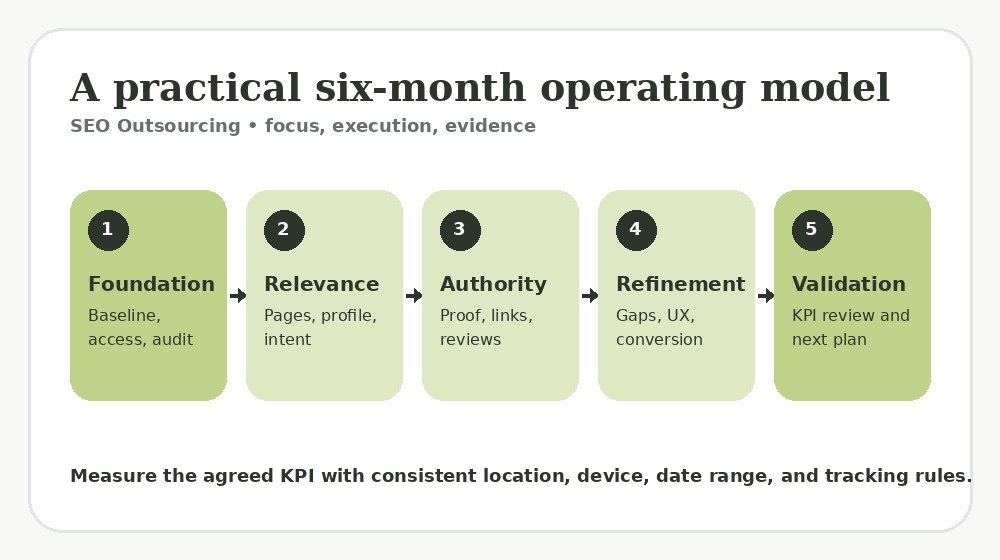
The central challenge is setting the right expectations before rankings and traffic have had time to respond. Consider a local SEO campaign moving from setup in month one to relevance and authority work in months two and three. This guide turns that situation into a practical, reviewable plan for agencies and local businesses—covering the decisions, deliverables, review checks and measurements needed for real delivery.
Use the first quarter to establish access, baselines, technical health, content priorities, and a repeatable operating rhythm. This guide focuses on onboarding, audits, quick wins, implementation, content, local foundations, reporting, and communication, with practical checks for deciding what to do next.
- Use the first quarter to establish access, baselines, technical health, content priorities, and a repeatable operating rhythm.
- Prioritise onboarding, audits, quick wins, implementation before expanding the scope or production volume.
- Track Access Completion, Technical Fixes Shipped, Pages Optimised with consistent definitions and data sources.
- Record approvals, dependencies and implementation evidence so delays and ownership stay visible.
Primary-source note: Google Search Essentials. Google recommends helpful, reliable, people-first content, crawlable links and descriptive language that helps users understand the page.
How to apply the framework in practice
Use the example of a local SEO campaign moving from setup in month one to relevance and authority work in months two and three as a test. The plan should explain what happens first, what can wait, what the business must supply, how quality is approved and which signal would justify expanding the scope. If those answers are missing, more content, more keywords or more reports will usually add management load before they add value.
1. Onboarding
Start with an access and dependency matrix. Record each property, owner, permission level, status and due date, together with the client decisions needed before work can ship. Missing access should be visible as a delivery risk, not discovered at the end of the month.
2. Audits
An audit should lead to decisions. Group findings by business impact, affected templates, confidence, effort and dependency, then distinguish urgent defects from opportunities and observations. A long export without prioritisation is not an implementation plan.
3. Quick Wins
Treat a quick win as a high-confidence change with low dependency, not simply an easy task. Correct broken indexation, inaccurate profile details, missing conversion tracking or obvious page mismatches first, and verify that the change reached production.
4. Implementation
Assign every recommendation to an owner and require evidence of deployment. For code or template changes, record the release date and affected URLs; for content or profile work, keep the approved version and a live URL. Re-test after implementation rather than assuming a closed task equals a fixed problem.
5. Content
Treat content as a decision point in the workflow. Document the inputs, expected output, owner and review standard so this part of “What to Expect in the First 90 Days of SEO Outsourcing” can be checked and improved instead of simply marked complete.
6. Local Foundations
Keep business identity data accurate and governed. Confirm the real-world name, address or service-area setup, phone, hours, website destination and authorised managers. Document who may edit the profile and how suggested changes, suspensions and ownership requests are handled.
7. Reporting
Treat reporting as a decision point in the workflow. Document the inputs, expected output, owner and review standard so this part of “What to Expect in the First 90 Days of SEO Outsourcing” can be checked and improved instead of simply marked complete.
8. Communication
Choose one system for tasks, one channel for urgent issues and a fixed review cadence. Every handoff should include the brief, source files, current status, next owner, due date and any unresolved decision so context is not lost across time zones.
Delivery checklist and acceptance tests
Use this table as an acceptance checklist. Each row should leave behind evidence that another reviewer can inspect.
| Workstream | Required output | Acceptance check |
|---|---|---|
| Onboarding | A concise onboarding record covering the decision, supporting evidence, owner and next action. | The onboarding work is specific, evidence-backed and ready for the next owner or implementation step. |
| Audits | a prioritised issue log with affected templates, impact, confidence, effort, owner and verification evidence | the recommendation is prioritised, deployed by an owner and confirmed through a re-test |
| Quick Wins | A concise quick wins record covering the decision, supporting evidence, owner and next action. | The quick wins work is specific, evidence-backed and ready for the next owner or implementation step. |
| Implementation | a prioritised issue log with affected templates, impact, confidence, effort, owner and verification evidence | the recommendation is prioritised, deployed by an owner and confirmed through a re-test |
| Content | a brief or page specification with intent, required evidence, structure, internal links and conversion action | the page answers the query, uses approved evidence, avoids unsupported claims and offers a clear next step |
| Local Foundations | A concise local foundations record covering the decision, supporting evidence, owner and next action. | The local foundations work is specific, evidence-backed and ready for the next owner or implementation step. |
How to measure progress without vanity reporting
For What to Expect in the First 90 Days of SEO Outsourcing, separate implementation signals from business outcomes. Keep the data source, filters and date range consistent so changes can be compared fairly.
- Access Completion: Measure from a defined start to an accepted finish and separate active work from time blocked by access or approval. The trend should help capacity planning and reveal bottlenecks, not reward rushed handoffs.
- Technical Fixes Shipped: Count only work that is live and verified. Keep a URL, screenshot, release note or re-test as evidence, and show blocked recommendations separately from completed implementation.
- Pages Optimised: Count only work that is live and verified. Keep a URL, screenshot, release note or re-test as evidence, and show blocked recommendations separately from completed implementation.
- Baseline Visibility: Use the same keyword, business, device, search origin and tool each time. Report distribution and coverage, not only the best point, and connect movement to the page or profile changes made during the period.
- Early Conversion Signals: Define the source, owner, date range and decision this measure supports. Keep the method stable, annotate major changes and avoid reporting the number without an interpretation or next action.
End each reporting cycle with an operational decision: keep, correct, consolidate, expand or stop the workstream. Separate delivery-team output from items blocked by access, approval or implementation.
Common mistakes that weaken results
1. Expecting immediate top rankings
No provider controls search engines, competitors or every client dependency. Set a qualified target, baseline, location and validation method, then communicate a range of likely outcomes and leading indicators instead of an absolute promise.
2. Delaying approvals
Work stalls when nobody owns the decision or deployment. Put the approver, due date, dependency and escalation path on the task, and show blocked time separately so it is not mistaken for completed delivery.
3. Changing targets weekly
Treat “Changing targets weekly” as a review failure, not a minor exception. Define what good looks like for this point, require supporting evidence, and correct the process if the same issue appears again.
4. Starting links before fixing the site
Treat “Starting links before fixing the site” as a review failure, not a minor exception. Define what good looks like for this point, require supporting evidence, and correct the process if the same issue appears again.
5. Reporting activity without decisions
Treat “Reporting activity without decisions” as a review failure, not a minor exception. Define what good looks like for this point, require supporting evidence, and correct the process if the same issue appears again.
A practical 90-day implementation sequence
Days 1–30: baseline and control
Start with onboarding, audits. Establish the baseline, access, owners and acceptance criteria before increasing production volume.
Days 31–60: build the priority assets
Implement quick wins, implementation, content. Review early outputs closely and turn repeated corrections into better briefs, templates or automated checks.
Days 61–90: validate and expand carefully
Validate local foundations, reporting, communication. Compare the new evidence with the baseline, then expand only the work that is producing reliable quality or commercial progress.
Related reading
- How to Outsource SEO to the Philippines: A Step-by-Step Agency Playbook
- SEO Outsourcing Philippines: A Complete Guide for Growing Agencies
- SEO Outsourcing Philippines
Need agency SEO outsourcing support?
See how our seo outsourcing for agencies workflow can support implementation after the recommendations in this guide.