
The central challenge is moving from ad hoc freelancers to a dependable outsourced delivery system. Consider an Australian agency that needs technical audits, on-page work, content briefs, and monthly reporting. This guide turns that situation into a practical, reviewable plan for agencies and local businesses—covering the decisions, deliverables, review checks and measurements needed for real delivery.
Launch a controlled pilot, document the workflow, and scale only after quality is proven. This guide focuses on scope design, trial projects, security, communication, documentation, and expansion, with practical checks for deciding what to do next.
- Launch a controlled pilot, document the workflow, and scale only after quality is proven.
- Prioritise scope design, trial projects, security, communication before expanding the scope or production volume.
- Track Pilot Pass Rate, Brief Clarity Score, Turnaround Consistency with consistent definitions and data sources.
- Record approvals, dependencies and implementation evidence so delays and ownership stay visible.
Primary-source note: Google Search Essentials. Google recommends helpful, reliable, people-first content, crawlable links and descriptive language that helps users understand the page.
How to apply the framework in practice
Use the example of an Australian agency that needs technical audits, on-page work, content briefs, and monthly reporting as a test. The plan should explain what happens first, what can wait, what the business must supply, how quality is approved and which signal would justify expanding the scope. If those answers are missing, more content, more keywords or more reports will usually add management load before they add value.
1. Scope Design
Begin with the smallest scope that can prove the workflow. Define the deliverables, volume, turnaround, quality threshold and review owner, then expand only after the pilot produces accepted work consistently and the exception rate is understood.
2. Trial Projects
Use a paid, time-boxed sample that resembles the work you will actually buy. Supply the same brief, access limits and acceptance criteria you would use for a client account, then score accuracy, judgement, communication, turnaround and revision quality.
3. Security
Apply least-privilege access. Use named accounts, a password manager, two-factor authentication where available and a documented offboarding checklist. Avoid shared administrator credentials and remove access promptly when a project or team member changes.
4. Communication
Choose one system for tasks, one channel for urgent issues and a fixed review cadence. Every handoff should include the brief, source files, current status, next owner, due date and any unresolved decision so context is not lost across time zones.
5. Documentation
Document the decisions that are expensive to rediscover: naming conventions, approved tools, source requirements, client preferences, exclusions and examples of accepted work. Keep the documentation close to the task so it is used during production, not only during training.
6. Expansion
Begin with the smallest scope that can prove the workflow. Define the deliverables, volume, turnaround, quality threshold and review owner, then expand only after the pilot produces accepted work consistently and the exception rate is understood.
Delivery checklist and acceptance tests
Use this table as an acceptance checklist. Each row should leave behind evidence that another reviewer can inspect.
| Workstream | Required output | Acceptance check |
|---|---|---|
| Scope Design | a scope-and-economics sheet that includes labour, software, third-party spend, rework and target margin | the price covers the real delivery effort and out-of-scope work cannot enter silently |
| Trial Projects | A concise trial projects record covering the decision, supporting evidence, owner and next action. | The trial projects work is specific, evidence-backed and ready for the next owner or implementation step. |
| Security | an access register with named users, permission level, two-factor status, owner and removal date | no person has more access than required and offboarding can be completed without shared credentials |
| Communication | A concise communication record covering the decision, supporting evidence, owner and next action. | The communication work is specific, evidence-backed and ready for the next owner or implementation step. |
| Documentation | a versioned workflow showing inputs, decision points, owner, due date, acceptance criteria and escalation path | a new team member can follow the process and knows what to do when the normal path breaks |
| Expansion | A concise expansion record covering the decision, supporting evidence, owner and next action. | The expansion work is specific, evidence-backed and ready for the next owner or implementation step. |
How to measure progress without vanity reporting
For How to Outsource SEO to the Philippines: A Step-by-Step Agency Playbook, separate implementation signals from business outcomes. Keep the data source, filters and date range consistent so changes can be compared fairly.
- Pilot Pass Rate: Score against written acceptance criteria and record the reason for each revision. First-pass acceptance is more useful than total output because it exposes brief quality, reviewer consistency and recurring process defects.
- Brief Clarity Score: Define the source, owner, date range and decision this measure supports. Keep the method stable, annotate major changes and avoid reporting the number without an interpretation or next action.
- Turnaround Consistency: Measure from a defined start to an accepted finish and separate active work from time blocked by access or approval. The trend should help capacity planning and reveal bottlenecks, not reward rushed handoffs.
- Hours Saved Internally: Define the source, owner, date range and decision this measure supports. Keep the method stable, annotate major changes and avoid reporting the number without an interpretation or next action.
- Cost Per Accepted Deliverable: Use fully loaded cost and attributable or assisted revenue where the data is credible. State attribution limitations and compare the trend by service or account rather than relying on a single blended average.
End each reporting cycle with an operational decision: keep, correct, consolidate, expand or stop the workstream. Separate delivery-team output from items blocked by access, approval or implementation.
Common mistakes that weaken results
1. Sending live client work as an undefined trial
Treat “Sending live client work as an undefined trial” as a review failure, not a minor exception. Define what good looks like for this point, require supporting evidence, and correct the process if the same issue appears again.
2. Sharing unnecessary credentials
This introduces platform, privacy or security risk that can outweigh any short-term gain. Use accurate real-world business information, least-privilege access and written rules for sensitive data and profile changes.
3. Assuming tools replace communication
Treat “Assuming tools replace communication” as a review failure, not a minor exception. Define what good looks like for this point, require supporting evidence, and correct the process if the same issue appears again.
4. Scaling before the pilot is stable
Treat “Scaling before the pilot is stable” as a review failure, not a minor exception. Define what good looks like for this point, require supporting evidence, and correct the process if the same issue appears again.
5. Changing the process every week
Treat “Changing the process every week” as a review failure, not a minor exception. Define what good looks like for this point, require supporting evidence, and correct the process if the same issue appears again.
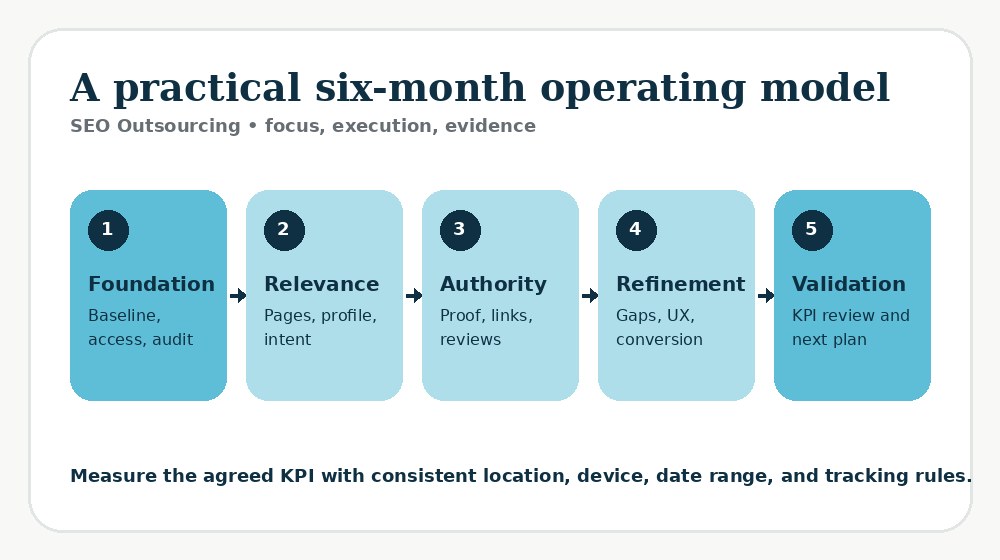
A practical 90-day implementation sequence
Days 1–30: baseline and control
Start with scope design, trial projects. Establish the baseline, access, owners and acceptance criteria before increasing production volume.
Days 31–60: build the priority assets
Implement security, communication. Review early outputs closely and turn repeated corrections into better briefs, templates or automated checks.
Days 61–90: validate and expand carefully
Validate documentation, expansion. Compare the new evidence with the baseline, then expand only the work that is producing reliable quality or commercial progress.
Related reading
- What to Expect in the First 90 Days of SEO Outsourcing
- SEO Outsourcing Philippines: A Complete Guide for Growing Agencies
- SEO Outsourcing Philippines
Need agency SEO outsourcing support?
See how our seo outsourcing for agencies workflow can support implementation after the recommendations in this guide.