
The central challenge is showing both visual quality and local relevance in competitive service areas. Consider a California landscaper targeting landscape design, pavers, irrigation, and ongoing maintenance. This guide turns that situation into a practical, reviewable plan for landscaping companies targeting design, construction, maintenance, and outdoor living projects—covering the decisions, deliverables, review checks and measurements needed for real delivery.
Turn search visibility into quote requests from customers who value the right type of work. This guide focuses on portfolio seo, service segmentation, image optimisation, local pages, reviews, and seasonal content, with practical checks for deciding what to do next.
- Turn search visibility into quote requests from customers who value the right type of work.
- Prioritise portfolio seo, service segmentation, image optimisation, local pages before expanding the scope or production volume.
- Track Quote Requests, Portfolio Page Visits, Image Search Entrances with consistent definitions and data sources.
- Record approvals, dependencies and implementation evidence so delays and ownership stay visible.
Primary-source note: Google Business Profile local ranking guidance. Google explains that local results are mainly shaped by relevance, distance and prominence, and recommends complete, accurate business information.
How to apply the framework in practice
Use the example of a California landscaper targeting landscape design, pavers, irrigation, and ongoing maintenance as a test. The plan should explain what happens first, what can wait, what the business must supply, how quality is approved and which signal would justify expanding the scope. If those answers are missing, more content, more keywords or more reports will usually add management load before they add value.
1. Portfolio SEO
Turn completed work into structured proof. Record the customer problem, location at an appropriate privacy level, scope, constraints, process, materials or methods, result and original images. A labelled project is more persuasive and more unique than a gallery with no context.
2. Service Segmentation
Treat service segmentation as a decision point in the workflow. Document the inputs, expected output, owner and review standard so this part of “Local SEO for Landscapers: From Map Rankings to Quote Requests” can be checked and improved instead of simply marked complete.
3. Image Optimisation
Use original, recent images that prove the business, people, equipment and completed work. Compress files, set accurate dimensions and descriptive alternative text, and avoid uploading the same generic stock image across multiple location or service pages.
4. Local Pages
Treat local pages as a decision point in the workflow. Document the inputs, expected output, owner and review standard so this part of “Local SEO for Landscapers: From Map Rankings to Quote Requests” can be checked and improved instead of simply marked complete.
5. Reviews
Build a compliant review process around real customers and completed work. Ask consistently, make the request easy, respond professionally and never gate, purchase or fabricate reviews. Review themes can also reveal service strengths, objections and content opportunities.
6. Seasonal Content
Plan seasonal content before demand peaks. Use previous enquiry patterns, weather, maintenance cycles and local events to identify when pages and offers should be refreshed. Publishing after the season begins leaves little time for discovery, indexing and authority to develop.
Delivery checklist and acceptance tests
Use this table as an acceptance checklist. Each row should leave behind evidence that another reviewer can inspect.
| Workstream | Required output | Acceptance check |
|---|---|---|
| Portfolio SEO | an organised evidence library with original files, captions, usage rights, page destination and descriptive alt text | The portfolio seo work is specific, evidence-backed and ready for the next owner or implementation step. |
| Service Segmentation | A concise service segmentation record covering the decision, supporting evidence, owner and next action. | The service segmentation work is specific, evidence-backed and ready for the next owner or implementation step. |
| Image Optimisation | an organised evidence library with original files, captions, usage rights, page destination and descriptive alt text | The image optimisation work is specific, evidence-backed and ready for the next owner or implementation step. |
| Local Pages | a brief or page specification with intent, required evidence, structure, internal links and conversion action | the page answers the query, uses approved evidence, avoids unsupported claims and offers a clear next step |
| Reviews | a compliant review-request and response workflow with owners, timing and escalation rules | the information matches the real business, complies with platform rules and is visible on the live profile |
| Seasonal Content | a brief or page specification with intent, required evidence, structure, internal links and conversion action | the page answers the query, uses approved evidence, avoids unsupported claims and offers a clear next step |
How to measure progress without vanity reporting
For Local SEO for Landscapers: From Map Rankings to Quote Requests, separate implementation signals from business outcomes. Keep the data source, filters and date range consistent so changes can be compared fairly.
- Quote Requests: Count the action by source, landing page, service and location, then review whether it was genuine, in scope and commercially useful. Raw volume should not include spam, existing-customer support or wrong-service enquiries.
- Portfolio Page Visits: Define the source, owner, date range and decision this measure supports. Keep the method stable, annotate major changes and avoid reporting the number without an interpretation or next action.
- Image Search Entrances: Review non-branded performance by landing page and query theme. Look for growth on priority service pages and compare it with engagement and qualified actions so informational traffic is not mistaken for commercial progress.
- Map-Pack Coverage: Define the source, owner, date range and decision this measure supports. Keep the method stable, annotate major changes and avoid reporting the number without an interpretation or next action.
- Lead Value By Service: Count the action by source, landing page, service and location, then review whether it was genuine, in scope and commercially useful. Raw volume should not include spam, existing-customer support or wrong-service enquiries.
End each review with a decision tied to visibility and lead quality: keep, correct, consolidate or expand the work. Separate completed SEO work from items blocked by business access, approvals or implementation.
Common mistakes that weaken results
1. Uploading uncompressed images
Treat “Uploading uncompressed images” as a review failure, not a minor exception. Define what good looks like for this point, require supporting evidence, and correct the process if the same issue appears again.
2. Mixing maintenance and construction intent
Treat “Mixing maintenance and construction intent” as a review failure, not a minor exception. Define what good looks like for this point, require supporting evidence, and correct the process if the same issue appears again.
3. Using no project locations
Treat “Using no project locations” as a review failure, not a minor exception. Define what good looks like for this point, require supporting evidence, and correct the process if the same issue appears again.
4. Ignoring seasonal demand
Treat “Ignoring seasonal demand” as a review failure, not a minor exception. Define what good looks like for this point, require supporting evidence, and correct the process if the same issue appears again.
5. Collecting reviews without service detail
Treat “Collecting reviews without service detail” as a review failure, not a minor exception. Define what good looks like for this point, require supporting evidence, and correct the process if the same issue appears again.
A practical 90-day implementation sequence
Days 1–30: baseline and control
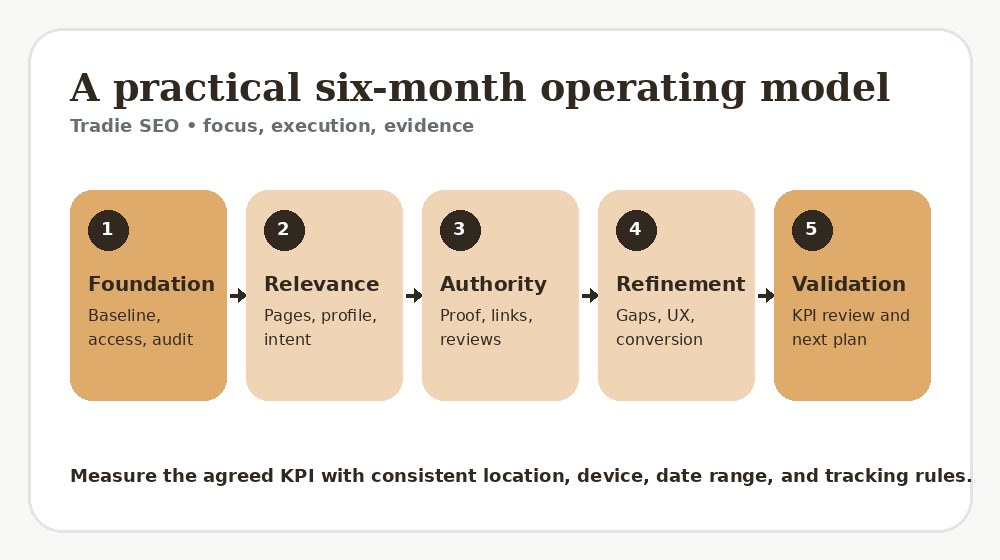
Start with portfolio seo, service segmentation. Establish the baseline, access, owners and acceptance criteria before increasing production volume.
Days 31–60: build the priority assets
Implement image optimisation, local pages. Review early outputs closely and turn repeated corrections into better briefs, templates or automated checks.
Days 61–90: validate and expand carefully
Validate reviews, seasonal content. Compare the new evidence with the baseline, then expand only the work that is producing reliable quality or commercial progress.
Related reading
- HVAC SEO: How Heating and Cooling Companies Can Dominate Local Search
- Local SEO for Electricians: A Six-Month Ranking Plan
- SEO Outsourcing Philippines
Need local SEO delivery support?
See how our local seo outsourcing workflow can support implementation after the recommendations in this guide.