The central challenge is improving relevance and prominence without resorting to spammy profile tactics. Consider a suburban clinic that ranks near its address but disappears several kilometres away. This guide turns that situation into a practical, reviewable plan for agencies and local businesses—covering the decisions, deliverables, review checks and measurements needed for real delivery.
Strengthen the profile, website, reputation, and local authority signals that support visibility. This guide focuses on categories, services, photos, reviews, landing pages, citations, local links, and map-grid tracking, with practical checks for deciding what to do next.
- Strengthen the profile, website, reputation, and local authority signals that support visibility.
- Prioritise categories, services, photos, reviews before expanding the scope or production volume.
- Track Map-Grid Coverage, Profile Calls, Website Clicks with consistent definitions and data sources.
- Record approvals, dependencies and implementation evidence so delays and ownership stay visible.
Primary-source note: Google Business Profile local ranking guidance. Google explains that local results are mainly shaped by relevance, distance and prominence, and recommends complete, accurate business information.
How to apply the framework in practice
Use the example of a suburban clinic that ranks near its address but disappears several kilometres away as a test. The plan should explain what happens first, what can wait, what the business must supply, how quality is approved and which signal would justify expanding the scope. If those answers are missing, more content, more keywords or more reports will usually add management load before they add value.
1. Categories
Choose the most specific accurate primary category and only add secondary categories that describe real services. Categories are not keywords; adding loosely related options can confuse relevance and create operational problems if the profile no longer reflects the business.
2. Services
Create a service matrix that connects what the business sells to demand, page ownership, proof and conversion paths. Group closely related services where one page can satisfy intent, and separate services when the customer problem, evidence or sales process is materially different.
3. Photos
Use original, recent images that prove the business, people, equipment and completed work. Compress files, set accurate dimensions and descriptive alternative text, and avoid uploading the same generic stock image across multiple location or service pages.
4. Reviews
Build a compliant review process around real customers and completed work. Ask consistently, make the request easy, respond professionally and never gate, purchase or fabricate reviews. Review themes can also reveal service strengths, objections and content opportunities.
5. Landing Pages
Map one primary intent to one strongest landing page. The page should make the service, location, proof and next action obvious. If several pages compete for the same query, consolidate or differentiate them before creating more content.
6. Citations
Treat citations as a decision point in the workflow. Document the inputs, expected output, owner and review standard so this part of “How to Improve Google Business Profile Rankings for Dentists” can be checked and improved instead of simply marked complete.
7. Local Links
Pursue links that make sense without an SEO metric: professional bodies, suppliers, local organisations, genuine sponsorships, useful resources and earned media. Relevance, editorial reason and referral value matter more than a single third-party score.
8. Map-grid Tracking
Track outcomes at the page and service level. Use tagged profile links, call tracking where lawful, form source fields and analytics events, then reconcile automated data with booked work. Attribution will never be perfect, but consistent rules make trends useful.
Delivery checklist and acceptance tests
Use this table as an acceptance checklist. Each row should leave behind evidence that another reviewer can inspect.
| Workstream | Required output | Acceptance check |
|---|---|---|
| Categories | A concise categories record covering the decision, supporting evidence, owner and next action. | The categories work is specific, evidence-backed and ready for the next owner or implementation step. |
| Services | A concise services record covering the decision, supporting evidence, owner and next action. | The services work is specific, evidence-backed and ready for the next owner or implementation step. |
| Photos | an organised evidence library with original files, captions, usage rights, page destination and descriptive alt text | The photos work is specific, evidence-backed and ready for the next owner or implementation step. |
| Reviews | a compliant review-request and response workflow with owners, timing and escalation rules | the information matches the real business, complies with platform rules and is visible on the live profile |
| Landing Pages | a brief or page specification with intent, required evidence, structure, internal links and conversion action | the page answers the query, uses approved evidence, avoids unsupported claims and offers a clear next step |
| Citations | A concise citations record covering the decision, supporting evidence, owner and next action. | The citations work is specific, evidence-backed and ready for the next owner or implementation step. |
How to measure progress without vanity reporting
For How to Improve Google Business Profile Rankings for Dentists, separate implementation signals from business outcomes. Keep the data source, filters and date range consistent so changes can be compared fairly.
- Map-Grid Coverage: Use the same keyword, business, device, search origin and tool each time. Report distribution and coverage, not only the best point, and connect movement to the page or profile changes made during the period.
- Profile Calls: Count the action by source, landing page, service and location, then review whether it was genuine, in scope and commercially useful. Raw volume should not include spam, existing-customer support or wrong-service enquiries.
- Website Clicks: Review non-branded performance by landing page and query theme. Look for growth on priority service pages and compare it with engagement and qualified actions so informational traffic is not mistaken for commercial progress.
- Review Velocity: Track legitimate new reviews, rating distribution, response time and recurring themes. Avoid targets that pressure staff to gate or incentivise customers; quality and authenticity matter more than a short burst of volume.
- Priority Treatment Visibility: Use the same keyword, business, device, search origin and tool each time. Report distribution and coverage, not only the best point, and connect movement to the page or profile changes made during the period.
End each review with a decision tied to visibility and lead quality: keep, correct, consolidate or expand the work. Separate completed SEO work from items blocked by business access, approvals or implementation.
Common mistakes that weaken results
1. Stuffing the business name
More terms do not automatically create more relevance. Excessive categories, repeated phrases or near-duplicate tracking targets blur the page or profile purpose and make reporting harder to interpret. Use a smaller set of accurate, commercially meaningful targets and let supporting language appear naturally.
2. Changing categories too frequently
Treat “Changing categories too frequently” as a review failure, not a minor exception. Define what good looks like for this point, require supporting evidence, and correct the process if the same issue appears again.
3. Using a virtual office
This introduces platform, privacy or security risk that can outweigh any short-term gain. Use accurate real-world business information, least-privilege access and written rules for sensitive data and profile changes.
4. Posting without improving core signals
Treat “Posting without improving core signals” as a review failure, not a minor exception. Define what good looks like for this point, require supporting evidence, and correct the process if the same issue appears again.
5. Judging performance from one location
The resulting number may look precise but cannot support a fair decision. Use fixed tools, locations, filters and date ranges, then report negative and positive movement together with conversions and implementation context.
A practical 90-day implementation sequence
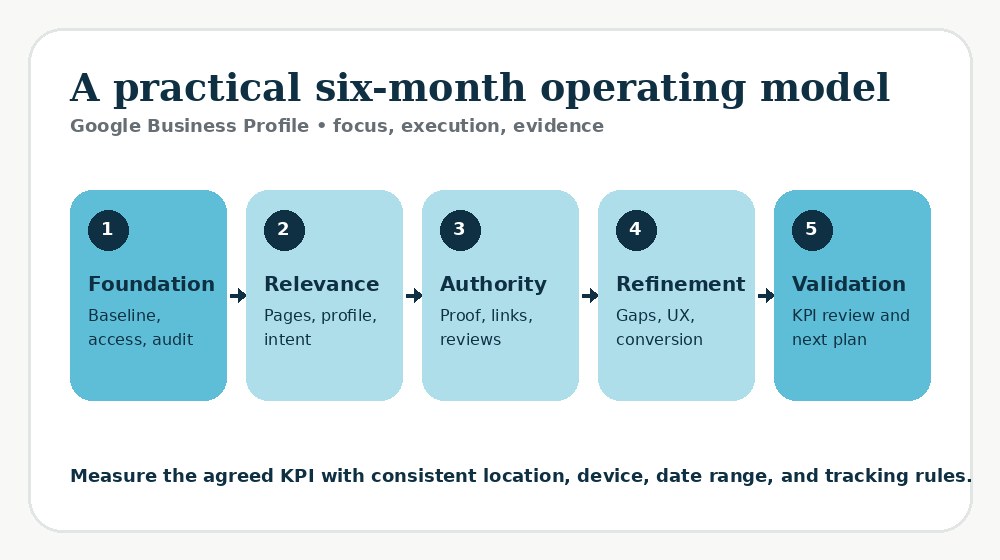
Days 1–30: baseline and control
Start with categories, services. Establish the baseline, access, owners and acceptance criteria before increasing production volume.
Days 31–60: build the priority assets
Implement photos, reviews, landing pages. Review early outputs closely and turn repeated corrections into better briefs, templates or automated checks.
Days 61–90: validate and expand carefully
Validate citations, local links, map-grid tracking. Compare the new evidence with the baseline, then expand only the work that is producing reliable quality or commercial progress.
Related reading
- Google Business Profile Optimisation Checklist for Local Businesses
- Map-Pack Rankings: How to Measure Google Maps Visibility Properly
- SEO Outsourcing Philippines
Need local SEO delivery support?
See how our local seo outsourcing workflow can support implementation after the recommendations in this guide.