The central challenge is turning undocumented expert knowledge into a repeatable delivery process. Consider an agency documenting how it prepares content briefs and performs on-page optimisation. This guide turns that situation into a practical, reviewable plan for agencies that want consistent outputs from internal and outsourced specialists—covering the decisions, deliverables, review checks and measurements needed for real delivery.
Create clear standard operating procedures with decision points, examples, and quality thresholds. This guide focuses on process mapping, templates, acceptance criteria, escalation rules, and version control, with practical checks for deciding what to do next.
- Create clear standard operating procedures with decision points, examples, and quality thresholds.
- Prioritise process mapping, templates, acceptance criteria, escalation rules before expanding the scope or production volume.
- Track SOP Adoption, First-Pass Acceptance, Training Time with consistent definitions and data sources.
- Record approvals, dependencies and implementation evidence so delays and ownership stay visible.
Primary-source note: Google Search Essentials. Google recommends helpful, reliable, people-first content, crawlable links and descriptive language that helps users understand the page.
How to apply the framework in practice
Use the example of an agency documenting how it prepares content briefs and performs on-page optimisation as a test. The plan should explain what happens first, what can wait, what the business must supply, how quality is approved and which signal would justify expanding the scope. If those answers are missing, more content, more keywords or more reports will usually add management load before they add value.
1. Process Mapping
Map the work from trigger to accepted output. Include required inputs, decision points, owner, tool, handoff and evidence of completion. A useful process map also shows where work can stop, loop back or require approval; otherwise it documents only the happy path.
2. Templates
Use templates to standardise structure, not to replace judgement. Lock the fields that must always be present, then leave room for context, evidence and recommendations. A strong template reduces omissions while still allowing the specialist to explain why the work matters.
3. Acceptance Criteria
Write acceptance criteria as observable checks rather than subjective instructions. “Optimise the page” is not testable; a stronger standard names the target intent, required elements, evidence, prohibited shortcuts and the person authorised to approve the result.
4. Escalation Rules
Define escalation thresholds before a problem occurs. State which issues stop publication, which can be corrected during normal review, who must be notified, and the response time expected for access, legal, factual, security or client-impacting risks.
5. Version Control
Give every operating document an owner, version number, effective date and change log. Archive superseded versions and link templates to the current source of truth so a remote contributor cannot accidentally follow an old process saved in a private folder.
Delivery checklist and acceptance tests
Use this table as an acceptance checklist. Each row should leave behind evidence that another reviewer can inspect.
| Workstream | Required output | Acceptance check |
|---|---|---|
| Process Mapping | a versioned workflow showing inputs, decision points, owner, due date, acceptance criteria and escalation path | a new team member can follow the process and knows what to do when the normal path breaks |
| Templates | a versioned workflow showing inputs, decision points, owner, due date, acceptance criteria and escalation path | a new team member can follow the process and knows what to do when the normal path breaks |
| Acceptance Criteria | A concise acceptance criteria record covering the decision, supporting evidence, owner and next action. | The acceptance criteria work is specific, evidence-backed and ready for the next owner or implementation step. |
| Escalation Rules | A concise escalation rules record covering the decision, supporting evidence, owner and next action. | The escalation rules work is specific, evidence-backed and ready for the next owner or implementation step. |
| Version Control | A concise version control record covering the decision, supporting evidence, owner and next action. | The version control work is specific, evidence-backed and ready for the next owner or implementation step. |
How to measure progress without vanity reporting
For How to Build an SEO SOP That an Outsourced Team Can Follow, separate implementation signals from business outcomes. Keep the data source, filters and date range consistent so changes can be compared fairly.
- SOP Adoption: Define the source, owner, date range and decision this measure supports. Keep the method stable, annotate major changes and avoid reporting the number without an interpretation or next action.
- First-Pass Acceptance: Score against written acceptance criteria and record the reason for each revision. First-pass acceptance is more useful than total output because it exposes brief quality, reviewer consistency and recurring process defects.
- Training Time: Measure from a defined start to an accepted finish and separate active work from time blocked by access or approval. The trend should help capacity planning and reveal bottlenecks, not reward rushed handoffs.
- Process Exceptions: Define the source, owner, date range and decision this measure supports. Keep the method stable, annotate major changes and avoid reporting the number without an interpretation or next action.
- Revision Frequency: Score against written acceptance criteria and record the reason for each revision. First-pass acceptance is more useful than total output because it exposes brief quality, reviewer consistency and recurring process defects.
End each reporting cycle with an operational decision: keep, correct, consolidate, expand or stop the workstream. Separate delivery-team output from items blocked by access, approval or implementation.
Common mistakes that weaken results
1. Writing vague checklists
The contributor is forced to guess the intent, evidence and standard, which creates avoidable rewrites. Supply an outcome-based brief, accepted examples, source rules and a clear definition of what will be approved.
2. Documenting only the happy path
Treat “Documenting only the happy path” as a review failure, not a minor exception. Define what good looks like for this point, require supporting evidence, and correct the process if the same issue appears again.
3. Forgetting examples
Treat “Forgetting examples” as a review failure, not a minor exception. Define what good looks like for this point, require supporting evidence, and correct the process if the same issue appears again.
4. Never updating the SOP
Treat “Never updating the SOP” as a review failure, not a minor exception. Define what good looks like for this point, require supporting evidence, and correct the process if the same issue appears again.
5. Measuring compliance instead of quality
Treat “Measuring compliance instead of quality” as a review failure, not a minor exception. Define what good looks like for this point, require supporting evidence, and correct the process if the same issue appears again.
A practical 90-day implementation sequence
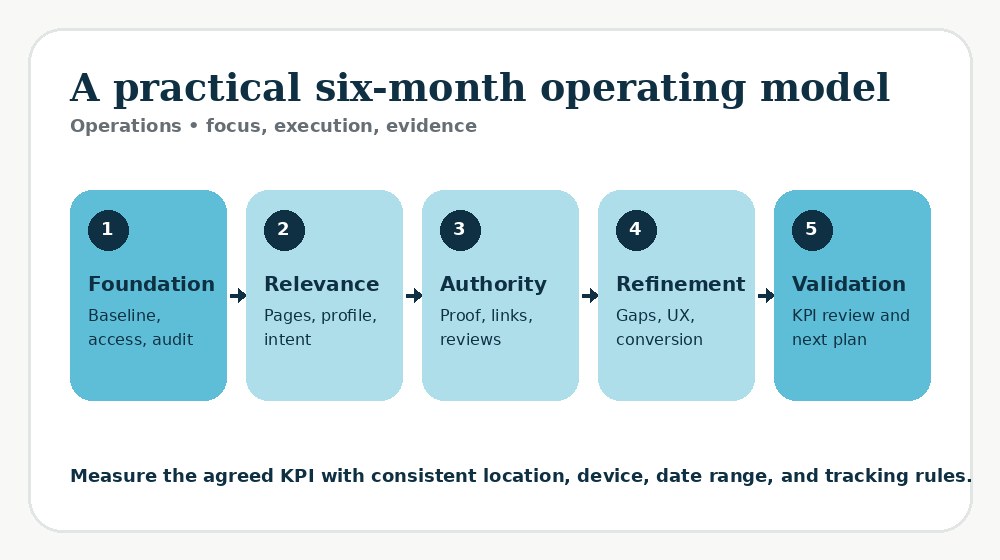
Days 1–30: baseline and control
Start with process mapping. Establish the baseline, access, owners and acceptance criteria before increasing production volume.
Days 31–60: build the priority assets
Implement templates, acceptance criteria. Review early outputs closely and turn repeated corrections into better briefs, templates or automated checks.
Days 61–90: validate and expand carefully
Validate escalation rules, version control. Compare the new evidence with the baseline, then expand only the work that is producing reliable quality or commercial progress.
Related reading
- The SEO Agency Fulfilment Checklist: From Sale to Monthly Report
- SEO Project Management: A Workflow for Agencies and Outsourced Teams
- SEO Outsourcing Philippines
Need agency SEO operations support?
See how our seo outsourcing for agencies workflow can support implementation after the recommendations in this guide.